![[yoe]](https://yoebuild.org/images/yoe-logo-amber.svg)
What a Modern Embedded Linux Build System Could Look Like
Seven weeks ago we started experimenting to find out. The result is a tool that builds QEMU and Raspberry Pi images today, with Docker support working. The goals driving the project, and where each one stands so far:
- Drastically improve developer productivity — shrink the loop between an
idea and a running image. Today: one binary, no SDK to install.
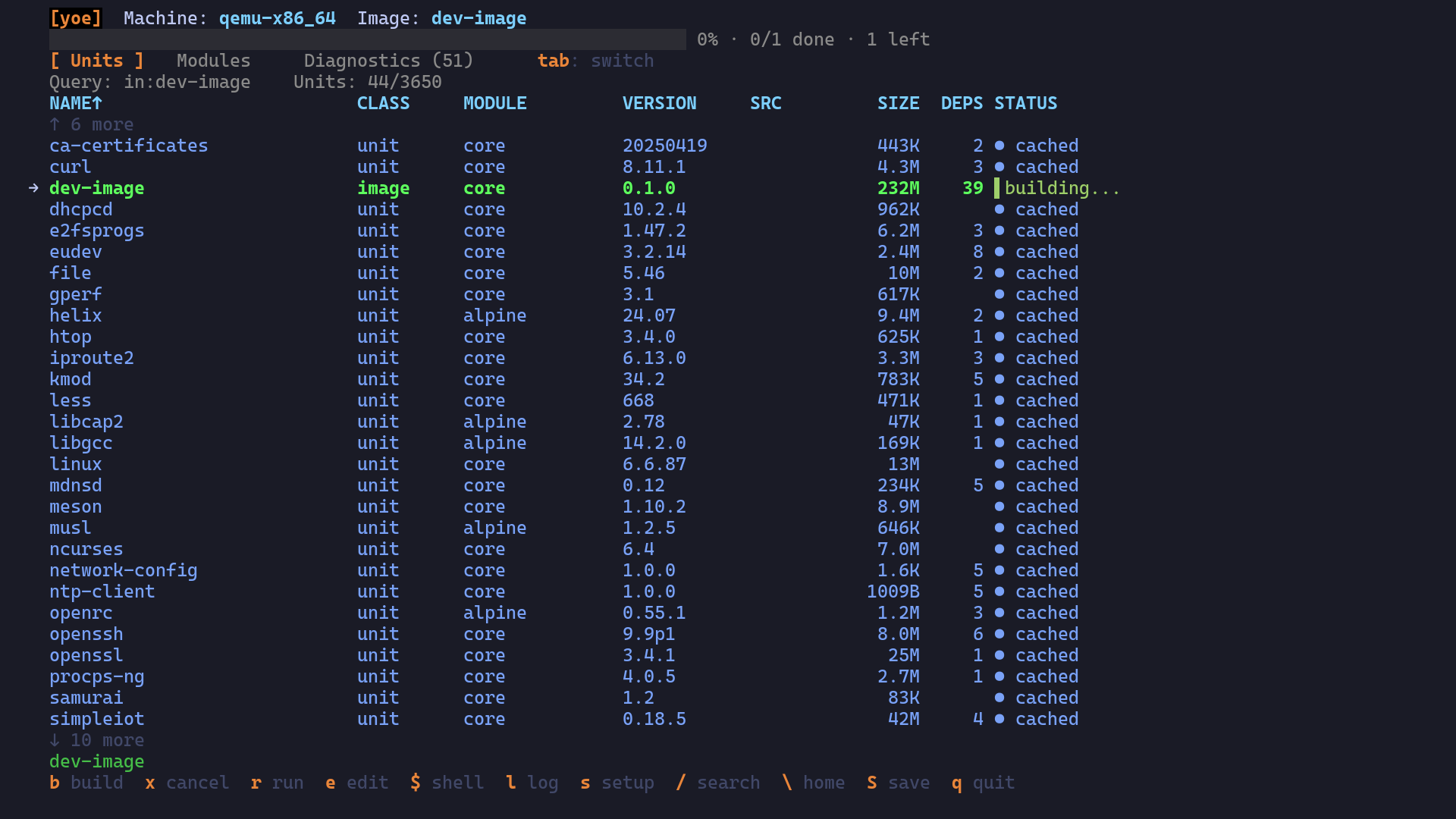
yoe init && yoeopens a TUI with a live build progress bar, andyoe runboots the image in QEMU. Background builds, search, and inline status sit in one screen. - Easily integrate complex workloads — let modern languages keep their own package managers, and let containers ride along. Today: Go modules build end-to-end, and Docker runs on the resulting image. Rust, Zig, and Python ML come next.
- Scale to build anything — one tool, one mental model from small images to
distributed systems. Today: two modules (
module-core,module-rpi) covering x86_64 QEMU and Raspberry Pi, with QEMU user-mode emulation building ARM64 on x86 — no cross-toolchain. Zephyr, AI workloads, distributed builds, and farm-scale caching are still ahead.
There is a long way to go, and the risks are real. But seven weeks in — 38 releases, a working build flow — the path forward feels solid.